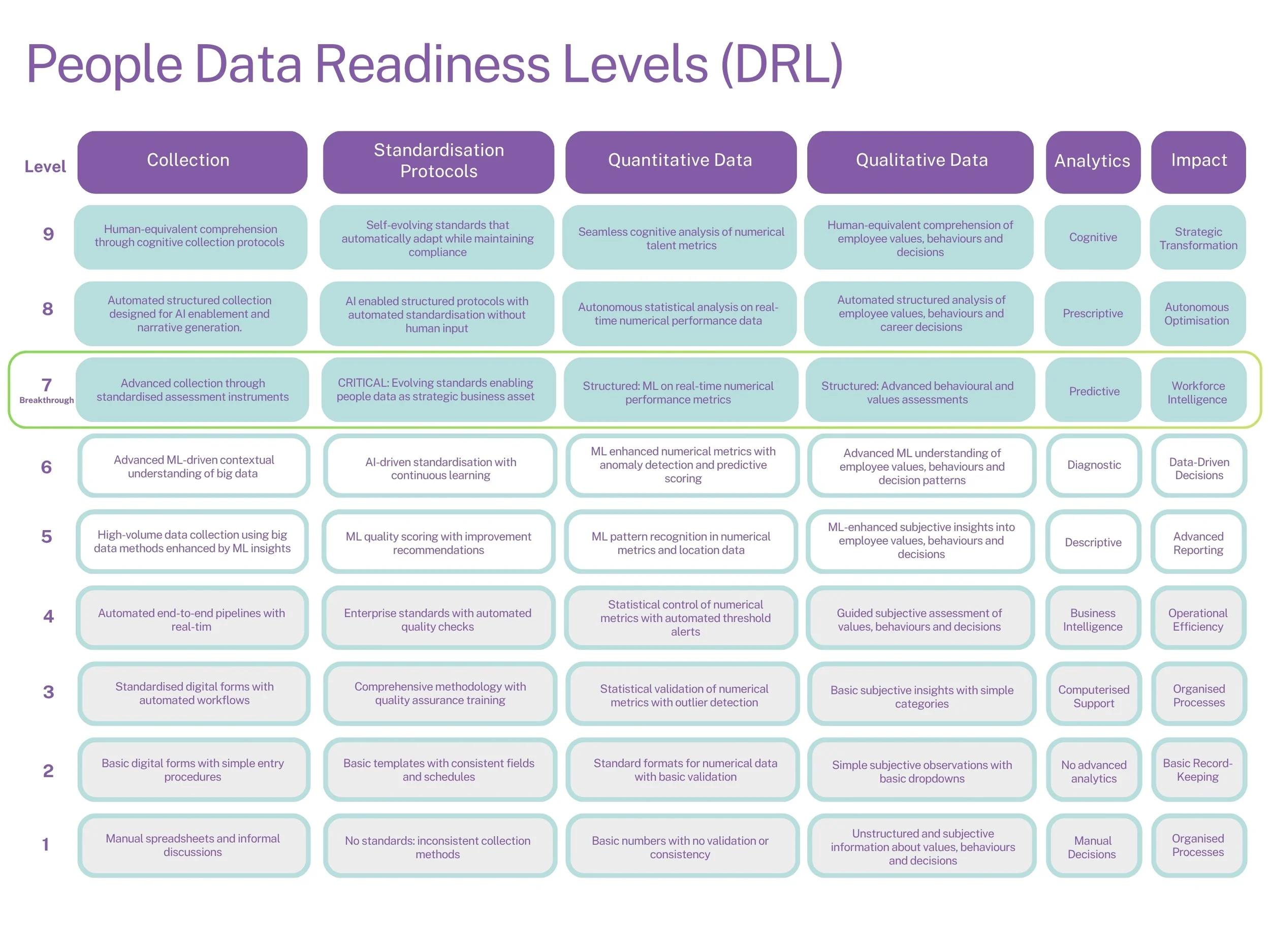
The Nine Levels of Data Readiness (DRLs)
DRL 1-2: Manual Collection Foundation
Organisations at these levels rely on manual data gathering through spreadsheets, emails, and basic forms. Data collection lacks consistency, and quality management is reactive. These levels cannot support AI applications because data lacks the reliability and structure that machine learning requires.
DRL 3-4: Digital Collection Infrastructure
These levels represent the implementation of basic digital data collection and storage systems with some quality controls. Whilst improved from manual approaches, data remains collected as a by-product of business processes rather than designed for analytical consumption. AI applications at these levels typically require extensive data preparation that consumes analytical resources.
DRL 5-6: Big Data Integration
Most organisations currently operate at these levels, implementing high-volume data collection enhanced by machine learning techniques. However, they continue treating data as a by-product of technology systems. Whilst these approaches support descriptive and diagnostic analytics, they plateau before achieving predictive analytics because the underlying data wasn't designed for AI consumption.
DRL 5-6 organisations typically experience the AI enablement challenges described earlier - inconsistent model performance, extensive data preparation requirements, and limited stakeholder confidence in AI-generated insights.
DRL 7: The Strategic Product Breakthrough
DRL 7 represents the critical transition where organisations implement Information Product principles, deploy Information Product Manager roles, and establish systematic quality management based on TDQM methodology. This breakthrough enables predictive analytics because data collection is intentionally designed to support AI consumption rather than hoping AI can overcome collection deficiencies.
At DRL 7, organisations move beyond big data approaches to structured data collection that directly addresses the ten root conditions undermining AI effectiveness. Instead of collecting everything and hoping to find patterns, they systematically collect structured information designed for intelligent analysis.
DRL 8-9: Advanced AI Integration
These levels represent emerging capabilities where automated structured collection integrates directly with AI systems to enable prescriptive and cognitive analytics. Whilst theoretically possible, these levels require collaborative exploration to validate practical implementation approaches.